Local detail
The Common Mistake
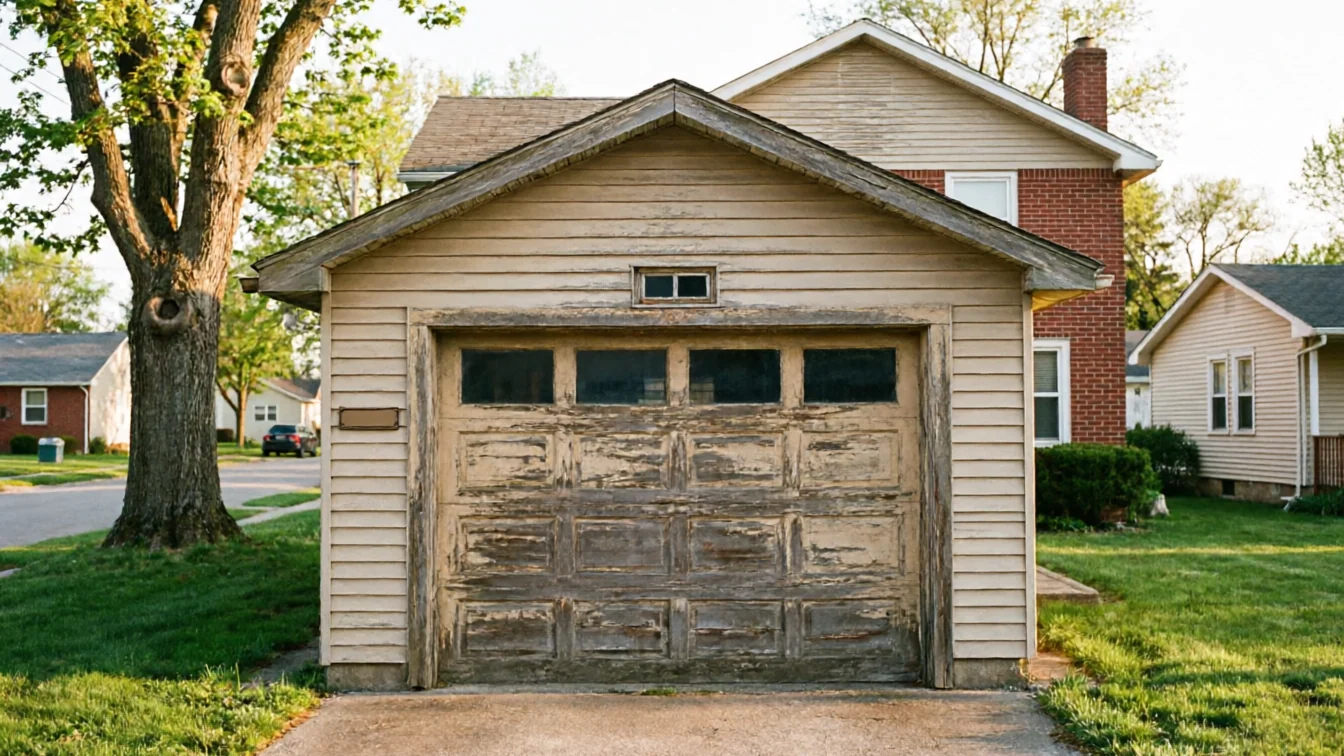
The mistake we see most in this area is waiting for a noise to turn into a jam before calling anyone. A lot of the houses around Grand Haven went up between 1945 and 1988, with the bulk of that stock dating to the 1960s and 70s. That means a huge share of the doors still in service are original or close to it, running on hardware that's had forty to sixty winters to work loose. A squeak on a door that age isn't background noise. It's a part telling you where it's wearing.
Owners tend to sort noise into one bucket - "the door's getting old" - and leave it there. But a dry hinge pin sounds different from a bent track, and a bent track sounds different from a spring that's losing tension. On a door built when Nixon was in office, all three are plausible at once, and guessing wrong means paying for a service call twice instead of once.
We're not going to tell you every creak needs a truck. Most don't. But on housing stock this old, the odds that a noise is purely cosmetic are lower than you'd think.
The area
The Situation
Across the Grand Haven service area there are roughly 16,400 households and about 8,790 owner-occupied houses, spread over eleven named neighborhoods that mostly share that same 1960s-70s build era. That's a lot of doors built to the same spec, aging on the same timeline, in the same lake-effect winters. It's also why a repair call here tends to follow a pattern: original torsion hardware, original extension springs on the older end of that range, and steel track that's taken fifty-some years of temperature swings.
With a median household income of $62,575 in the area, replacement isn't always the first move people reach for, and it shouldn't be. A lot of these doors are mechanically sound under the surface rust and just need the right part swapped. The trouble is that original hardware from 1968 doesn't always match what's on the shelf today, so a repair on an older door sometimes takes an extra trip to source the right bracket or drum. We tell people that upfront rather than let them assume same-day on every job.
What we find
When It Stops Being a DIY Job
A door that groans on the way up and whines on the way down, on a house from this era, usually means dry rollers or a hinge that's never been lubricated - fix it yourself with white lithium grease and fifteen minutes. That's the limit of what we'd call a reasonable DIY job here.
Past that line, step back. A loud bang followed by the door going slack is a cable or spring letting go, and on a torsion system from the 1960s or 70s, that spring is under enough load to break a hand or worse. A grinding noise that gets worse each cycle is usually a track bent out of alignment, and on steel that's been through decades of Michigan winters, forcing it back into shape yourself just moves the bend somewhere else.
The honest limitation: we don't recommend DIY spring replacement on any door, any age, full stop. It's the one repair where the margin for a bad outcome isn't worth the money saved. If your door is making a noise you can't place, that's reason enough to stop opening it until someone's looked at the spring and the track together, not just the symptom you can hear.
How we work
What the Weather Here Does to It
Grand Haven sits in a severe cold climate band, and that matters more to an older door than people expect. Steel track contracts in deep cold, and on hardware installed decades ago, that contraction is enough to turn a slightly loose bracket into a noisy one almost overnight once temperatures drop. Grease that was fine in August turns stiff in January, which is why a lot of noise complaints here cluster in the cold months - it's not that the door broke, it's that cold exposed a weakness that summer was hiding.
Lake-effect swings also mean more freeze-thaw cycles than a lot of inland towns see, and each cycle works on any gap in weatherstripping or any play in an aging roller track. On a door built to 1970s-era tolerances, that adds up faster than on new hardware. If your door's noise shows up specifically when it's cold and quiets down in summer, that's a strong sign the issue is metal contraction or thickened lubricant, not a part that's actually failing - worth knowing before you spend money chasing a sound that's seasonal, not structural.
Talk to a local pro
Garage door trouble in Grand Haven?
Same-day service with honest, upfront quotes.